Source: Natasha Frost / The History Channel
In July 1911, along the East Coast of the United States, temperatures climbed into the 90s and stayed there for days and days, killing 211 people in New York alone. At the end of Pike Street, in Lower Manhattan, a young man leapt off a pier and into the water, after hours of trying to nap in a shady corner. As he jumped, he called: “I can’t stand this any longer.” Meanwhile, up in Harlem, an overheated laborer attempted to throw himself in front of a train, and had to be wrestled into a straitjacket by police.
In an age before air conditioning or widespread use of electric fans, many struggled to cope with this multi-day deadly heat. June had been easy enough, but a sweep of hot, dry air from the southern plains suppressed any relief from the ocean breeze. In Providence, Rhode Island, temperatures rose 11 degrees in a single half hour. New York City and Philadelphia became sweltering centers of chaos, while all across New England, railway tracks buckled, mail service was suspended and people perished beneath the sun. Total death tolls are estimated to have topped 2000 in just a few weeks.
Though temperatures never quite broke 100 degrees in the first two weeks of July in New York, the city was poorly equipped to handle the heat, and the humidity that went with it. Poor ventilation and cramped living spaces exacerbated the problem, ultimately leading to the deaths of old and young alike, with children as small as two weeks old becoming overcome by the heat.
In the peaks of the wave, people abandoned their apartments for the cool grass of New York’s public spaces, napping beneath trees in Central Park or seeking shade in Battery Park. In Boston, 5,000 people chose to spend the night on Boston Common rather than risk suffocation in their own homes. Babies wailed through the night—or failed to wake up at all.
The streets were anarchic: People reportedly ran mad in the heat (one drunken fool, described by the New York Tribuneas “partly crazed by the heat,” attacked a policeman with a meat cleaver), while horses collapsed and were left to rot by the side of the road.
Around July 7, when temperatures returned to ordinary levels of July sweat, the humidity remained high. It was this, reported the New York Times, that was responsible for so many of the casualties, “catching its victims in an exhausted state and killing all of them within the hours between 7 and 10 a.m.” The New York Tribunephrased it still more dramatically: “The monstrous devil that had pressed New York under his burning thumb for five days could not go without one last curse, and when the temperature dropped called humidity to its aid.”
Outside of New York, however, temperatures had climbed higher still. In Boston, people
struggled in 104 degree heat; in Bangor, Maine and Nashua, New Hampshire, it reached a record-breaking 106. In Woodbury, New York, a farmer left his field when the outside temperature hit 140 degrees—hot enough to melt candle wax. People didn’t just die from exhaustion or heat stroke, but from their efforts to escape the sweltering air. Some 200 people died from drowning as they dove head first into the ocean, ponds, rivers and lakes.
City authorities did what they could to handle the heat, including flushing fire hydrants to cool off streets. In Hartford, Connecticut, people rode around on free ferries and trolleys, trying to catch some kind of a breeze, while a local brewer donated water barrels to parks. Factories were closed and mail delivery was suspended as transport went haywire: boats oozed pitch and railways buckled in the heat. “The tar surface on some streets is boiling like syrup in the sun,” reported the Hartford Courant, “making things sticky for vehicles as well as pedestrians.”
At the end of the first week, even a terrific thunderstorm did little to alleviate the discomfort. In New York, the Times reported, it was simply a few showers “accompanied by much thunder, which rumbled as early as 5:45 a.m., giving promise of big things, and then disappeared into the ocean.”
In Boston, the storm had disastrous consequences, damaging already charred property throughout the town and killing those who strayed into its path. A second thunderstorm, around the 13th, finally brought temperatures back down to manageable levels. As it did so, however, five more people died from lightning strikes. The record-breaking heat wave was over, but at still greater cost for the exhausted, grieving people of New England.
Source:
Tuesday, July 9, 2019
Sunday, January 20, 2019
The 18th-Century Craze for Gin
by Mark Forsyth ~ June 12, 2018
Inspiring oddities from mass public nudity to a mechanical gin-selling cat, the craze for gin swept across London and much of England during the first half of the 18th century. Writing for History Extra, Mark Forsyth, author of A Short History of Drunkenness, explores the history behind this alcoholic spirit.
Gin causes women to spontaneously combust. Or, at least, that was the theory. There are two documented cases of British ladies downing gin and going up in smoke, and a few more of European women doing the same with brandy. The matter was taken seriously enough to be discussed by the Royal Society in 1745.
We don’t take stories of spontaneous human combustion that seriously any more (for reasons I’ll get back to), but for a historian, the stories are fascinating because they’re part of the great Gin Panic. This was the moralising and serious counterpart to the great Gin Craze that swept London and much of England in the first half of the 18th century and produced (aside from the ignited ladies) mass public nudity, burning babies, and a mechanical gin-selling cat.
Alcoholic spirits were a pretty new commodity in 18th-century society, though they had actually been around for a long time. They started as a chemical curiosity in about the 10th century AD. They were being drunk by the very, very rich for pleasure by about 1500, as shown when James IV of Scotland bought several barrels of whisky. But even a hundred years later, in 1600, there was only one recorded bar in England that sold spirits to the curious (just outside London, towards Barking).
Then in about 1700, spirits hit. The reasons are complicated and involve taxation of grain and the relations with the Dutch, but the important thing is that gin suddenly became widely available to Londoners, which was a good thing for the gin-sellers as Londoners needed a drink. The turn of the 18th century was a great period of urbanisation, when the poor of England flocked to London in search of streets paved with gold and Bubbles from South Sea [the South Sea Bubble was a speculation boom in the early 1710s], only to find that the streets were paved with mud and there was no work to be had. London’s population was around 600,000. There were only two other towns in England with populations of 20,000. London was the first grand, anonymous city. There were none of the social constraints of a village where everybody knew everybody’s business. And there were none of the financial safeguards either, with a parish that would support its native poor, or the family and friends who might have looked after you at home. Instead, there was gin.
A craze among the poor
It’s very hard to say which was bigger – the craze for drinking gin that swept the lower classes, or the moral panic at the sight of so many gin drinkers that engulfed the ruling classes. Anonymous hordes of poor, often homeless people wandered the city drinking away their sorrows, and often their clothes, as they readily exchanged their garments for the spirit.
Before the industrial revolution and the rash of cotton mills that would fill the north of England a century later, cloth was very expensive. Beggars really did dress in rags, if at all, and the obvious thing to sell if you really needed money fast was, literally, the shirt on your back. The descriptions left to us by the ‘Gin Panickers’ would be funny – if they weren’t so tragic.
Indeed, the most notorious single incident of the gin craze was the case of Judith Defour, a young woman with a daughter and no obvious husband. The daughter, Mary, had been taken into care by the parish workhouse and provided with a nice new set of clothes. One Sunday, in January 1734, Judith Defour came to take Mary out for the day and didn’t return her. Instead, she strangled her own child and sold the new clothes to buy gin.
Judith Defour was probably mentally unwell anyway, but her case became a public sensation, because it summed up everything that people thought about the new craze for drinking gin: she was poor; she was a woman and she was a mother. Judith was selling clothes for alcohol and as the clothes had been provided by the workhouse, she was therefore taking advantage of the rudimentary social security system, combining benefits fraud with infanticide.
The arrival of gin
Before gin had come on the scene, Englishmen had drunk beer. English women had drunk it too – up
to a point – but beer and the alehouses where it was served had always been seen as basically male domains. Gin, which was new and exotic and metropolitan, didn’t have any of these old associations. There were no rules around gin. There were no social norms about who could drink it, or when you could drink it, or how much of it you could drink. A lot of places served it in pints because, well… that’s what you drank. A country boy newly arrived in the city wasn’t going to drink a thimbleful of something.
This was, quite literally, put to the test in 1741, when a group of Londoners offered a farm labourer a shilling for each pint of gin he could sink. He managed three, and then dropped down dead. It’s amazing he got that far, as gin, in those days, was about twice as strong as it is now and contained some interesting flavourings. Some distillers used to add sulphuric acid, just to give it some bite.
And so the efforts to ban drinking among the lower classes began. And they didn’t work very well. When authorities decided to ban the sale of gin, there were fully fledged riots. The poor didn’t want their drug of choice taken away. They loved ‘Madam Geneva’, as they called the spirit.
In any case, the government decided to tax the living daylights out of it. But people simply didn’t pay the tax, so government tried to pay informants to hand in unlicensed gin-sellers. This attempt turned ugly as a number of mobs formed to attack even suspected informants, and several people were beaten to death. Not that the informants were necessarily that nice; they could, and some did, run the whole thing as a protection racket – “pay me or I’ll claim the reward from the government”. And into this chaos it’s almost unsurprising that a mechanical cat should make an entry.
The Puss-and-Mew machine
The contraption known as the ‘Puss-and-Mew machine’ was simple. The gin-seller found a window in alleyway that was nowhere near the building’s front door. The window was covered boarded over with a wooden cat. The gin-buyer would approach and say to the cat: “Puss, give me two pennyworth of gin,” and then place the coins in the cat’s mouth. These would slide inwards to the gin-seller who would pour the gin down a lead pipe that emerged under the cat’s paw. The crowds loved it and the inventor, Dudley Bradstreet, made three or four pounds a day, which was a lot of money. As nobody witnessed both sides of the transaction, no charges could be brought.
The Gin Craze was a classic example of a drug without social norms. Every society on earth has had its narcotics (and almost every society has chosen alcohol). But those narcotics have come with social rules about when, where, how and why you ‘get blasted’. Every age and every society is different. Today, young adults tend to get drunk on a Friday evening, while in medieval England, the preferred time was Sunday morning. In ancient Egypt, it was the Festival of Hathor and in ancient China, it was during the rites that honoured the family dead.
Nowadays, gin is just another spirit, but in the 18th century, gin had no norms, no rules, no mythology and no associations. It was anyone’s, and that was its danger: a danger that in the popular imagination was easily transmuted into spontaneous female combustion.
A final note on these combustible ladies: they were all reasonably old and reasonably well off. The strange thing about spontaneous human combustion is that in all cases the body is reduced to a small pile of ashes, whilst nearby objects – however burnable – are not even singed. A human body actually burns at around 1,200 degrees Celsius. A burning house rarely gets above about 800 degrees. So, while the stories don’t stand up scientifically, a society that believes such stories is very good for those who stand to inherit the victim’s fortune.
Inspiring oddities from mass public nudity to a mechanical gin-selling cat, the craze for gin swept across London and much of England during the first half of the 18th century. Writing for History Extra, Mark Forsyth, author of A Short History of Drunkenness, explores the history behind this alcoholic spirit.
Gin causes women to spontaneously combust. Or, at least, that was the theory. There are two documented cases of British ladies downing gin and going up in smoke, and a few more of European women doing the same with brandy. The matter was taken seriously enough to be discussed by the Royal Society in 1745.
We don’t take stories of spontaneous human combustion that seriously any more (for reasons I’ll get back to), but for a historian, the stories are fascinating because they’re part of the great Gin Panic. This was the moralising and serious counterpart to the great Gin Craze that swept London and much of England in the first half of the 18th century and produced (aside from the ignited ladies) mass public nudity, burning babies, and a mechanical gin-selling cat.
Alcoholic spirits were a pretty new commodity in 18th-century society, though they had actually been around for a long time. They started as a chemical curiosity in about the 10th century AD. They were being drunk by the very, very rich for pleasure by about 1500, as shown when James IV of Scotland bought several barrels of whisky. But even a hundred years later, in 1600, there was only one recorded bar in England that sold spirits to the curious (just outside London, towards Barking).
Then in about 1700, spirits hit. The reasons are complicated and involve taxation of grain and the relations with the Dutch, but the important thing is that gin suddenly became widely available to Londoners, which was a good thing for the gin-sellers as Londoners needed a drink. The turn of the 18th century was a great period of urbanisation, when the poor of England flocked to London in search of streets paved with gold and Bubbles from South Sea [the South Sea Bubble was a speculation boom in the early 1710s], only to find that the streets were paved with mud and there was no work to be had. London’s population was around 600,000. There were only two other towns in England with populations of 20,000. London was the first grand, anonymous city. There were none of the social constraints of a village where everybody knew everybody’s business. And there were none of the financial safeguards either, with a parish that would support its native poor, or the family and friends who might have looked after you at home. Instead, there was gin.
A craze among the poorIt’s very hard to say which was bigger – the craze for drinking gin that swept the lower classes, or the moral panic at the sight of so many gin drinkers that engulfed the ruling classes. Anonymous hordes of poor, often homeless people wandered the city drinking away their sorrows, and often their clothes, as they readily exchanged their garments for the spirit.
Before the industrial revolution and the rash of cotton mills that would fill the north of England a century later, cloth was very expensive. Beggars really did dress in rags, if at all, and the obvious thing to sell if you really needed money fast was, literally, the shirt on your back. The descriptions left to us by the ‘Gin Panickers’ would be funny – if they weren’t so tragic.
Indeed, the most notorious single incident of the gin craze was the case of Judith Defour, a young woman with a daughter and no obvious husband. The daughter, Mary, had been taken into care by the parish workhouse and provided with a nice new set of clothes. One Sunday, in January 1734, Judith Defour came to take Mary out for the day and didn’t return her. Instead, she strangled her own child and sold the new clothes to buy gin.
Judith Defour was probably mentally unwell anyway, but her case became a public sensation, because it summed up everything that people thought about the new craze for drinking gin: she was poor; she was a woman and she was a mother. Judith was selling clothes for alcohol and as the clothes had been provided by the workhouse, she was therefore taking advantage of the rudimentary social security system, combining benefits fraud with infanticide.
The arrival of gin
Before gin had come on the scene, Englishmen had drunk beer. English women had drunk it too – up to a point – but beer and the alehouses where it was served had always been seen as basically male domains. Gin, which was new and exotic and metropolitan, didn’t have any of these old associations. There were no rules around gin. There were no social norms about who could drink it, or when you could drink it, or how much of it you could drink. A lot of places served it in pints because, well… that’s what you drank. A country boy newly arrived in the city wasn’t going to drink a thimbleful of something.
This was, quite literally, put to the test in 1741, when a group of Londoners offered a farm labourer a shilling for each pint of gin he could sink. He managed three, and then dropped down dead. It’s amazing he got that far, as gin, in those days, was about twice as strong as it is now and contained some interesting flavourings. Some distillers used to add sulphuric acid, just to give it some bite.
And so the efforts to ban drinking among the lower classes began. And they didn’t work very well. When authorities decided to ban the sale of gin, there were fully fledged riots. The poor didn’t want their drug of choice taken away. They loved ‘Madam Geneva’, as they called the spirit.
In any case, the government decided to tax the living daylights out of it. But people simply didn’t pay the tax, so government tried to pay informants to hand in unlicensed gin-sellers. This attempt turned ugly as a number of mobs formed to attack even suspected informants, and several people were beaten to death. Not that the informants were necessarily that nice; they could, and some did, run the whole thing as a protection racket – “pay me or I’ll claim the reward from the government”. And into this chaos it’s almost unsurprising that a mechanical cat should make an entry.
The Puss-and-Mew machineThe contraption known as the ‘Puss-and-Mew machine’ was simple. The gin-seller found a window in alleyway that was nowhere near the building’s front door. The window was covered boarded over with a wooden cat. The gin-buyer would approach and say to the cat: “Puss, give me two pennyworth of gin,” and then place the coins in the cat’s mouth. These would slide inwards to the gin-seller who would pour the gin down a lead pipe that emerged under the cat’s paw. The crowds loved it and the inventor, Dudley Bradstreet, made three or four pounds a day, which was a lot of money. As nobody witnessed both sides of the transaction, no charges could be brought.
The Gin Craze was a classic example of a drug without social norms. Every society on earth has had its narcotics (and almost every society has chosen alcohol). But those narcotics have come with social rules about when, where, how and why you ‘get blasted’. Every age and every society is different. Today, young adults tend to get drunk on a Friday evening, while in medieval England, the preferred time was Sunday morning. In ancient Egypt, it was the Festival of Hathor and in ancient China, it was during the rites that honoured the family dead.
Nowadays, gin is just another spirit, but in the 18th century, gin had no norms, no rules, no mythology and no associations. It was anyone’s, and that was its danger: a danger that in the popular imagination was easily transmuted into spontaneous female combustion.
A final note on these combustible ladies: they were all reasonably old and reasonably well off. The strange thing about spontaneous human combustion is that in all cases the body is reduced to a small pile of ashes, whilst nearby objects – however burnable – are not even singed. A human body actually burns at around 1,200 degrees Celsius. A burning house rarely gets above about 800 degrees. So, while the stories don’t stand up scientifically, a society that believes such stories is very good for those who stand to inherit the victim’s fortune.
Sitting Up With the Dead: Lost Appalachian Burial Customs
by Hope ~ December 15, 2017
From the peaks of the Blue Ridge and the Great Smoky Mountains, to the river valleys of the French Broad and Catawba, North Carolina has a long history that is steeped in rich Appalachian traditions.
Despite the Hollywood “hillbilly” stereotype, Appalachians carry a sense of pride for their culture, language, and heritage.
Isolated from the outside world, Appalachian regions have long struggled with rough rocky terrain for farming and plagued with poverty. Immigrants from Europe began migrating to the area in the 18th century with a large proportion of the population being Ulster Scots and Scotch-Irish. Many pioneers moved into areas largely separated from civilization by high mountain ridges and our pioneer ancestors were rugged, self-sufficient and brought many traditions from the Celtic Old World that is still a part of Appalachian culture today.
If you grew up Appalachian, you usually had a family relative who was gifted and could foresee approaching death, omens or dreams of things to come.
There was always a granny witch to call on when someone was sick and needed special magic for healing. Superstitions about death were common and were considered God’s will. One thing for sure, no matter how hard you fought it, death always won.
Appalachian folks are no stranger to death. For the Dark Horseman visited so frequently, houses were made with two front doors. One door was used for happy visits and the other door, known as the funeral door, would open into the deathwatch room for sitting up with the dead. Prior to the commercialization of the funeral industry, funeral homes and public cemeteries were virtually nonexistent in the early days of the Appalachian settlers.
For Whom the Bell Tolls…
In small Appalachian villages, the local church bell would toll to alert others a death has occurred. Depending on the age of the deceased, the church bell would chime once for every year of their life they had lived on this earth. Family and friends quickly stop what they were doing and gather at the deceased family’s homestead to comfort loved ones. Women in the community would bring food as the immediate family would make funeral preparations for burial. The men would leave their fields to meet together and dig a hole for the grave and the local carpenter would build a coffin based on the deceased loved one’s body measurements.
Due to the rocky terrain, sometimes dynamite was used to clear enough rock for the body to be buried. Coffins used to be made from trunks of trees called “tree coffins”. Over time, pine boxes replaced the tree coffins. They were lined with cloth usually made from cotton, linen or silk and the outside of the coffin was covered in black material. If a person died in the winter, the ground would be too frozen to dig a grave. In this case, the dead would simply be placed in a protected area outdoors until spring.
After the bell tolls, every mirror in the home would be draped with dark cloth and curtains would be closed. It was believed that by covering the mirror, a returning spirit could not use the looking glass as a portal and would cross over into their new life. The swinging hands on the clock were stopped not only to record the time of death, but it was believed that when a person died, time stood still for them.
Preparing the Body
Before the use of embalming, the burial would be the next day since there were no means of preserving the body. To prepare the body, the deceased would be “laid out” and remained in the home until burial. The body would be placed on a cooling board or “laying out” board. Depending on the family, the “laying out” board might be a door taken off the hinges, a table, ironing board or piece of lumber. Many families had a specific board for the purpose of laying out the body that had been passed down from generations.
The “laying out” board would then be placed on two chairs or sawhorses so the body could be stretched out straight. Depending on what position the person was in when they died, sometimes it was necessary to break bones or soak parts of the body in warm water to get the corpse flat on the board. As rigor mortis began to set in, some folks have actually heard bones cracking and breaking which would cause the corpse to move as it began to stiffen. The board would then be covered with a sheet and a rope was used to tie the body down to keep it straight and to prevent it from suddenly jerking upright.
Scottish traditions used the process of saining which is a practice of blessing and protecting the body. Saining was performed by the oldest woman in the family. The family member would light a candle and wave it over the corpse three times. Three handfuls of salt were put into a wooden bowl and placed on the body’s chest to prevent the corpse from rising unexpectedly.
Once the body was laid out, their arms were folded across the chest and legs brought together and tied near the feet. A handkerchief was tied under the chin and over the head to keep the corpse’s mouth from opening. To prevent discoloration of the skin, a towel was soaked in soda water and placed over the face until time for viewing. Aspirin and water were also used sometimes to prevent the dead from darkening. If the loved one died with their eyes open, weights or coins were placed over the eyes to close them.
Silver coins or 50 cent pieces were used instead of pennies because the copper would turn the skin green. Once the corpse was in place, the body would then be washed with warm soap and water. Then family members would dress the loved one in their best attire which was usually already picked out by the person before they passed. The body of the dead is never left alone until it was time to take the deceased for burial.
Sitting Up With the Dead
After the body has been prepared, the body is placed in the handmade coffin for viewing and placed
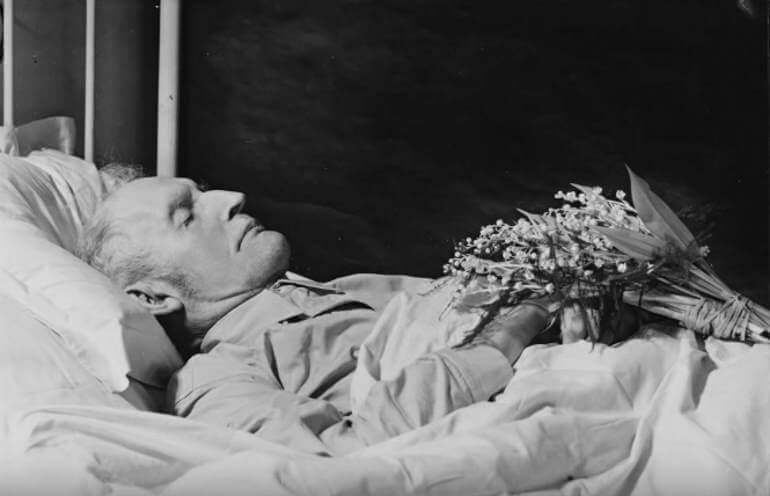
in the parlor or funeral room. The custom of “sitting up with the dead” is also called a “Wake”. Most times a handmade quilt would be placed over the body along with flowers and herbs. The ritual of sending flowers to a funeral came from this very old tradition. The aroma from the profusion of flowers around the deceased helped mask the odor of decomposition.
Flowers as a form of grave decoration were not widely used in the United States until after the mid-nineteenth century. In the Southern Appalachians, traditional grave decorations included personal effects, toys, and other items such as shells, rocks, and pottery sherds. Bunches of wildflowers and weeds, homemade plant or vegetable wreaths, and crepe paper flowers gradually attained popularity later in the nineteenth century. Placing formal flower arrangements on graves was gradually incorporated into traditional decoration day events in the twentieth century.
The day after the Wake, the body would be loaded into a wagon and taken to the church for the funeral service. Family and friends walked behind the wagon all dressed in black. The church bell would toll until the casket was brought into the church. This would be the last viewing as friends and family walked past the casket to take a final look at the body. Some would place a variety of objects in the coffin such as jewelry, tobacco, pipes, toys, a bible and every once in an alcoholic beverage.
Today, a strong sense of community continues to dominate Appalachian burial customs even though the modern funeral industry has changed the customs slightly. The social dimension has changed completely since caskets are commercially produced and graves are seldom dug by hand. Modern funeral homes have made the task of burial more convenient but the downside is there is less personal involvement. Personalized care for the dead is an important aspect of family and community life in Appalachia. And we can certainly say for sure that the days of conducting the entire procedure necessary to bury a person, all done by caring neighbors, with no charge involved, are no longer practiced.
From the peaks of the Blue Ridge and the Great Smoky Mountains, to the river valleys of the French Broad and Catawba, North Carolina has a long history that is steeped in rich Appalachian traditions. Despite the Hollywood “hillbilly” stereotype, Appalachians carry a sense of pride for their culture, language, and heritage.
Isolated from the outside world, Appalachian regions have long struggled with rough rocky terrain for farming and plagued with poverty. Immigrants from Europe began migrating to the area in the 18th century with a large proportion of the population being Ulster Scots and Scotch-Irish. Many pioneers moved into areas largely separated from civilization by high mountain ridges and our pioneer ancestors were rugged, self-sufficient and brought many traditions from the Celtic Old World that is still a part of Appalachian culture today.
If you grew up Appalachian, you usually had a family relative who was gifted and could foresee approaching death, omens or dreams of things to come.
There was always a granny witch to call on when someone was sick and needed special magic for healing. Superstitions about death were common and were considered God’s will. One thing for sure, no matter how hard you fought it, death always won.
Appalachian folks are no stranger to death. For the Dark Horseman visited so frequently, houses were made with two front doors. One door was used for happy visits and the other door, known as the funeral door, would open into the deathwatch room for sitting up with the dead. Prior to the commercialization of the funeral industry, funeral homes and public cemeteries were virtually nonexistent in the early days of the Appalachian settlers.
For Whom the Bell Tolls…
In small Appalachian villages, the local church bell would toll to alert others a death has occurred. Depending on the age of the deceased, the church bell would chime once for every year of their life they had lived on this earth. Family and friends quickly stop what they were doing and gather at the deceased family’s homestead to comfort loved ones. Women in the community would bring food as the immediate family would make funeral preparations for burial. The men would leave their fields to meet together and dig a hole for the grave and the local carpenter would build a coffin based on the deceased loved one’s body measurements.
Due to the rocky terrain, sometimes dynamite was used to clear enough rock for the body to be buried. Coffins used to be made from trunks of trees called “tree coffins”. Over time, pine boxes replaced the tree coffins. They were lined with cloth usually made from cotton, linen or silk and the outside of the coffin was covered in black material. If a person died in the winter, the ground would be too frozen to dig a grave. In this case, the dead would simply be placed in a protected area outdoors until spring.
After the bell tolls, every mirror in the home would be draped with dark cloth and curtains would be closed. It was believed that by covering the mirror, a returning spirit could not use the looking glass as a portal and would cross over into their new life. The swinging hands on the clock were stopped not only to record the time of death, but it was believed that when a person died, time stood still for them.
Preparing the BodyBefore the use of embalming, the burial would be the next day since there were no means of preserving the body. To prepare the body, the deceased would be “laid out” and remained in the home until burial. The body would be placed on a cooling board or “laying out” board. Depending on the family, the “laying out” board might be a door taken off the hinges, a table, ironing board or piece of lumber. Many families had a specific board for the purpose of laying out the body that had been passed down from generations.
The “laying out” board would then be placed on two chairs or sawhorses so the body could be stretched out straight. Depending on what position the person was in when they died, sometimes it was necessary to break bones or soak parts of the body in warm water to get the corpse flat on the board. As rigor mortis began to set in, some folks have actually heard bones cracking and breaking which would cause the corpse to move as it began to stiffen. The board would then be covered with a sheet and a rope was used to tie the body down to keep it straight and to prevent it from suddenly jerking upright.
Scottish traditions used the process of saining which is a practice of blessing and protecting the body. Saining was performed by the oldest woman in the family. The family member would light a candle and wave it over the corpse three times. Three handfuls of salt were put into a wooden bowl and placed on the body’s chest to prevent the corpse from rising unexpectedly.
Once the body was laid out, their arms were folded across the chest and legs brought together and tied near the feet. A handkerchief was tied under the chin and over the head to keep the corpse’s mouth from opening. To prevent discoloration of the skin, a towel was soaked in soda water and placed over the face until time for viewing. Aspirin and water were also used sometimes to prevent the dead from darkening. If the loved one died with their eyes open, weights or coins were placed over the eyes to close them.
Silver coins or 50 cent pieces were used instead of pennies because the copper would turn the skin green. Once the corpse was in place, the body would then be washed with warm soap and water. Then family members would dress the loved one in their best attire which was usually already picked out by the person before they passed. The body of the dead is never left alone until it was time to take the deceased for burial.
Sitting Up With the Dead
After the body has been prepared, the body is placed in the handmade coffin for viewing and placed
in the parlor or funeral room. The custom of “sitting up with the dead” is also called a “Wake”. Most times a handmade quilt would be placed over the body along with flowers and herbs. The ritual of sending flowers to a funeral came from this very old tradition. The aroma from the profusion of flowers around the deceased helped mask the odor of decomposition.
Flowers as a form of grave decoration were not widely used in the United States until after the mid-nineteenth century. In the Southern Appalachians, traditional grave decorations included personal effects, toys, and other items such as shells, rocks, and pottery sherds. Bunches of wildflowers and weeds, homemade plant or vegetable wreaths, and crepe paper flowers gradually attained popularity later in the nineteenth century. Placing formal flower arrangements on graves was gradually incorporated into traditional decoration day events in the twentieth century.
The day after the Wake, the body would be loaded into a wagon and taken to the church for the funeral service. Family and friends walked behind the wagon all dressed in black. The church bell would toll until the casket was brought into the church. This would be the last viewing as friends and family walked past the casket to take a final look at the body. Some would place a variety of objects in the coffin such as jewelry, tobacco, pipes, toys, a bible and every once in an alcoholic beverage.
Today, a strong sense of community continues to dominate Appalachian burial customs even though the modern funeral industry has changed the customs slightly. The social dimension has changed completely since caskets are commercially produced and graves are seldom dug by hand. Modern funeral homes have made the task of burial more convenient but the downside is there is less personal involvement. Personalized care for the dead is an important aspect of family and community life in Appalachia. And we can certainly say for sure that the days of conducting the entire procedure necessary to bury a person, all done by caring neighbors, with no charge involved, are no longer practiced.
Tuesday, January 15, 2019
Remembering Boston's Deadly Molasses Flood, 100 Years Later
January 15, 2019
Julia Press, WNPR
On a brisk winter day, Stephen Puleo, author of "Dark Tide: The Great Boston Molasses Flood of 1919," gestured toward the spot where a tank in Boston's North End burst, releasing a tsunami of hot molasses into the streets 100 years ago, on Jan. 15, 1919.
"So, that green sign right there is exactly the site of the outside wall of the tank," he said. "Ships that would come up from Puerto Rico, Cuba and the West Indies would pull up right along here. There was a pipe right here that led to the molasses tank, and they would offload gallons of molasses into the tank."
The tank was built to be a holding vessel for molasses until it could be transported to a nearby distillery, where it was converted into industrial alcohol for World War I munitions. By the time of the flood, the war was over, and the molasses inside was expected to become rum in the last days before Prohibition.
Perched right on Boston Harbor, the tank was perfectly situated in a hub of trade activity.
"This was one of the busiest commercial sites in all of Boston," Puleo said. "Almost all of the shipping that left Boston to go up and down the East Coast, to go to Europe, left from this site. So there were deliveries all day long, this was a bustling, hustling kind of place."
There were signs that the tank was faltering, but the people of the North End had gotten used to its instability.
"There were often comments made by people around the vicinity that this tank would shudder and
groan every time it was full, and it leaked from day one," Puleo said. "It was very customary for children of the North End to go and collect molasses with pails."
So on the day of the flood, despite leaks and groans, no one anticipated that the tank was about to burst, unleashing a wave of 2.3 million gallons of molasses that would move 35 miles an hour down Commercial Street.
"It collects and destroys buildings, people, domestic animals, stables — there are about 25 horses that are killed," Puleo said. "About 21 people die, 150 people injured seriously. And I’m talking injuries like broken backs, fractured skulls."
Harry Howe was on leave from the Navy for the weekend when the flood occurred. On a boat docked in the harbor, Howe witnessed the incident firsthand, as he recalled in a 1981 interview with the Stoneham Public Library: "We saw this big cloud of brown dust and dirt and a slight noise. And there was an arm sticking out from underneath the wheel of a truck. So two of us got a hold of his arm and pulled and unfortunately, we pulled his arm off."
Howe and other sailors were some of the first people on the scene, helping with rescue efforts where they could.
Researchers like Ronald Mayville have been fascinated by this incident, studying the causes behind it as a phenomenon of science and engineering.
"No one knows exactly why [the tank] failed, but one thing is very clear: It was under-designed," he said. "Whoever did the design failed to provide the adequate thickness of the steel. On top of that, it looks like the method that they used to make the rivet holes — the way that they put the tank together in those days was by riveting, not welding — was substandard, and that that may have created small cracks, and on top of that, the steel that they used, although it was state-of-the-art of the day, we know today that it could be relatively brittle under certain circumstances."
It’s no wonder the tank burst. U.S. Industrial Alcohol, the company that owned the tank, had rushed to build it, employing an overseer who was an expert in finance, not engineering. When the company received complaints that the tank was leaking, it painted the tank brown to disguise the leaks rather than repair them.
Besides the structural aspects of the tank, researchers have explored how the scientific properties of the molasses itself explain why the flood was so destructive.
"It’s mostly the density of the molasses, so how much it weighs, and how tall it is," explained Nicole Sharp, an aerospace engineer and science educator, who has studied the fluid dynamics of molasses. "You basically have a giant stack of something that’s really heavy and as soon as you remove whatever’s holding that — in this case, the walls of the tank — all of that is going to rush out, and a lot of that potential energy that you had from stacking this thing up really high is going to turn into kinetic energy. It might as well be a tsunami."
Two days before the accident, a new shipment of hot molasses had been added to the tank, so when it burst, the molasses inside might have been slightly warmer than the outside air. As it spilled out, it cooled down and thickened, trapping survivors in the mess. Rescue efforts continued for days, and cleanup took even longer.
Immediately following the flood, 119 plaintiffs took up a civil lawsuit against U.S. Industrial Alcohol, the tank’s owner. The case was historic in many ways.
"[It was] the first case in which expert witnesses were called to a great extent: engineers, metallurgists, architects, technical people," Puleo said. "So really kind of a landmark, important case. There were over 1,000 witnesses called in this case, 1,500 exhibits, and really kind of sets the stage for future class action lawsuits."
Puleo described how the case's ruling would completely change the relationship between business and government.
"There were very few regulations — public regulations, employee safety regulations — that businesses had to follow. So all the things we now take for granted in the business: that architects need to show their work, that engineers need to sign and seal their plans, that building inspectors need to come out and look at projects. ... All of that comes about as a result of the Great Boston Molasses Flood case."
What’s more, the accident brought an end to what had long been a thriving industry. U.S. Industrial Alcohol never rebuilt its tank, and the company closed its Boston production plant shortly after the tank’s collapse. And for a short time, the story was all anyone could talk about.
"Boston has seven daily newspapers at the time, and the Molasses flood is so big for about a week that it knocks off the front page the Prohibition amendment which essentially passes the night of the Molasses flood, and it knocks the Versailles peace talks, the talks that ended World War I, off the front page, so it’s an enormous story in Boston at the time," Puleo said.
Boston politicians responded with outrage, but it didn’t last long. Puleo thinks that’s because of who was living in the North End — mostly Italian immigrants. They didn’t have the political power to stop industry from taking over their waterfront, or molasses from leaking onto the streets. And today, their story has been largely forgotten, aside from a plaque in the spot where the tank once stood.
This story was first published by Connecticut Public Radio.
Fatalities
Julia Press, WNPR
On a brisk winter day, Stephen Puleo, author of "Dark Tide: The Great Boston Molasses Flood of 1919," gestured toward the spot where a tank in Boston's North End burst, releasing a tsunami of hot molasses into the streets 100 years ago, on Jan. 15, 1919.
"So, that green sign right there is exactly the site of the outside wall of the tank," he said. "Ships that would come up from Puerto Rico, Cuba and the West Indies would pull up right along here. There was a pipe right here that led to the molasses tank, and they would offload gallons of molasses into the tank."
The tank was built to be a holding vessel for molasses until it could be transported to a nearby distillery, where it was converted into industrial alcohol for World War I munitions. By the time of the flood, the war was over, and the molasses inside was expected to become rum in the last days before Prohibition.
Perched right on Boston Harbor, the tank was perfectly situated in a hub of trade activity.
"This was one of the busiest commercial sites in all of Boston," Puleo said. "Almost all of the shipping that left Boston to go up and down the East Coast, to go to Europe, left from this site. So there were deliveries all day long, this was a bustling, hustling kind of place."
There were signs that the tank was faltering, but the people of the North End had gotten used to its instability.
"There were often comments made by people around the vicinity that this tank would shudder and
groan every time it was full, and it leaked from day one," Puleo said. "It was very customary for children of the North End to go and collect molasses with pails."
So on the day of the flood, despite leaks and groans, no one anticipated that the tank was about to burst, unleashing a wave of 2.3 million gallons of molasses that would move 35 miles an hour down Commercial Street.
"It collects and destroys buildings, people, domestic animals, stables — there are about 25 horses that are killed," Puleo said. "About 21 people die, 150 people injured seriously. And I’m talking injuries like broken backs, fractured skulls."
Harry Howe was on leave from the Navy for the weekend when the flood occurred. On a boat docked in the harbor, Howe witnessed the incident firsthand, as he recalled in a 1981 interview with the Stoneham Public Library: "We saw this big cloud of brown dust and dirt and a slight noise. And there was an arm sticking out from underneath the wheel of a truck. So two of us got a hold of his arm and pulled and unfortunately, we pulled his arm off."
Howe and other sailors were some of the first people on the scene, helping with rescue efforts where they could.
Researchers like Ronald Mayville have been fascinated by this incident, studying the causes behind it as a phenomenon of science and engineering.
"No one knows exactly why [the tank] failed, but one thing is very clear: It was under-designed," he said. "Whoever did the design failed to provide the adequate thickness of the steel. On top of that, it looks like the method that they used to make the rivet holes — the way that they put the tank together in those days was by riveting, not welding — was substandard, and that that may have created small cracks, and on top of that, the steel that they used, although it was state-of-the-art of the day, we know today that it could be relatively brittle under certain circumstances."
It’s no wonder the tank burst. U.S. Industrial Alcohol, the company that owned the tank, had rushed to build it, employing an overseer who was an expert in finance, not engineering. When the company received complaints that the tank was leaking, it painted the tank brown to disguise the leaks rather than repair them.
Besides the structural aspects of the tank, researchers have explored how the scientific properties of the molasses itself explain why the flood was so destructive.
"It’s mostly the density of the molasses, so how much it weighs, and how tall it is," explained Nicole Sharp, an aerospace engineer and science educator, who has studied the fluid dynamics of molasses. "You basically have a giant stack of something that’s really heavy and as soon as you remove whatever’s holding that — in this case, the walls of the tank — all of that is going to rush out, and a lot of that potential energy that you had from stacking this thing up really high is going to turn into kinetic energy. It might as well be a tsunami."
Two days before the accident, a new shipment of hot molasses had been added to the tank, so when it burst, the molasses inside might have been slightly warmer than the outside air. As it spilled out, it cooled down and thickened, trapping survivors in the mess. Rescue efforts continued for days, and cleanup took even longer.
Immediately following the flood, 119 plaintiffs took up a civil lawsuit against U.S. Industrial Alcohol, the tank’s owner. The case was historic in many ways.
"[It was] the first case in which expert witnesses were called to a great extent: engineers, metallurgists, architects, technical people," Puleo said. "So really kind of a landmark, important case. There were over 1,000 witnesses called in this case, 1,500 exhibits, and really kind of sets the stage for future class action lawsuits."
Puleo described how the case's ruling would completely change the relationship between business and government.
"There were very few regulations — public regulations, employee safety regulations — that businesses had to follow. So all the things we now take for granted in the business: that architects need to show their work, that engineers need to sign and seal their plans, that building inspectors need to come out and look at projects. ... All of that comes about as a result of the Great Boston Molasses Flood case."
What’s more, the accident brought an end to what had long been a thriving industry. U.S. Industrial Alcohol never rebuilt its tank, and the company closed its Boston production plant shortly after the tank’s collapse. And for a short time, the story was all anyone could talk about.
"Boston has seven daily newspapers at the time, and the Molasses flood is so big for about a week that it knocks off the front page the Prohibition amendment which essentially passes the night of the Molasses flood, and it knocks the Versailles peace talks, the talks that ended World War I, off the front page, so it’s an enormous story in Boston at the time," Puleo said.
Boston politicians responded with outrage, but it didn’t last long. Puleo thinks that’s because of who was living in the North End — mostly Italian immigrants. They didn’t have the political power to stop industry from taking over their waterfront, or molasses from leaking onto the streets. And today, their story has been largely forgotten, aside from a plaque in the spot where the tank once stood.
This story was first published by Connecticut Public Radio.
Fatalities
|
Name
|
Age
|
Occupation
|
|
Patrick Breen
|
44
|
Laborer (North End Paving Yard)
|
|
William Brogan
|
61
|
Teamster
|
|
Bridget Clougherty
|
65
|
Homemaker
|
|
Stephen Clougherty
|
34
|
Unemployed
|
|
John Callahan
|
43
|
Paver (North End Paving Yard)
|
|
Maria Di Stasio
|
10
|
Child
|
|
William Duffy
|
58
|
Laborer (North End Paving Yard)
|
|
Peter Francis
|
64
|
Blacksmith (North End Paving Yard)
|
|
Flaminio Gallerani
|
37
|
Driver
|
|
Pasquale Iantosca
|
10
|
Child
|
|
James H. Kenneally
|
Unknown
|
Laborer (North End Paving Yard)
|
|
Eric Laird
|
17
|
Teamster
|
|
George Layhe
|
38
|
Firefighter (Engine 31)
|
|
James Lennon
|
64
|
Teamster/Motorman
|
|
Ralph Martin
|
21
|
Driver
|
|
James McMullen
|
46
|
Foreman, Bay State Express
|
|
Cesar Nicolo
|
32
|
Expressman
|
|
Thomas Noonan
|
43
|
Longshoreman
|
|
Peter Shaughnessy
|
18
|
Teamster
|
|
John M. Seiberlich
|
69
|
Blacksmith (North End Paving Yard)
|
|
Michael Sinnott
|
78
|
Messenger
|
Victim List Courtesy of the Boston Globe
Thursday, September 13, 2018
So You Think *You're* Crazy??
Here is a list of reasons people were committed to the Trans Allegheny Lunatic Asylum from 1864 to 1889. Seems women were much more susceptible to institutionalization than men for things such as: marriage of son, imaginary female trouble, rumor of husband murder (just a rumor???). Men could be admitted for things such as: falling from a horse in war, business nerves, excitement as officer. Or you could even be committed for your religious enthusiasm, political excitement, or your parents being cousins (which was pretty common back then). It's pretty sobering to think you could be committed for such banal things.
Monday, April 23, 2018
The Long and Short of the Letter S in Olde English Printing and Script
The origins of the long s,[Å¿] can be traced all the way back to old Roman cursive, a script used in Rome for everyday, informal writing from the first century AD to about the third century. In this script, the letter s was written as a vertical down-stroke with a small curve at the end of it, and a diagonal upstroke at the top. It looked almost like a check mark, with an added diagonal line on top
of it. In new Roman cursive, which developed between the third and seventh century AD, s was written almost as we write the lowercase r today: a vertical down-stroke, followed by an upstroke with a curve. This was the type of s that found its place in the Carolingian script, which was developed in the court of Charlemagne in order to provide a uniform and legible form of writing. It’s in this script that the r-like form evolved into the long s we see in the Bill of Rights.
If you’re wondering what the s we know and use today was doing during that time, don’t worry, it was there. It’s just that it was used as the uppercase S, mostly, up until the eleventh or twelfth century. Around that time, the long s started to be used when the letter appeared at the beginning or in the middle of a word, and by the fifteenth century, this practice seemed to become established. So, the word “sound” would have been written as “Å¿ound,” and the word “rest” would have been written as “reÅ¿t.” The short s (also known as the round s) was used at the end of a word, or after a long s which appeared in the middle of a word. That’s why the word “processes” would have been written like this: “proceÅ¿ses.”
The long s was used in the vast majority of books published in English during the 17th and 18th centuries, but suddenly and dramatically fell out of fashion at the end of the 18th century, reflecting the widespread adoption of new, modern typefaces based on those developed by Bodini and Didot during the 1790s.
The intentional exclusion first occurred in a major publication in 1785 with Englishman John Bell's printing of Shakespeare. In the Prolegomena to the Dramatick Writings of Will Shakespeare (1788), Bell explains why he omitted the long s. This was the aim of many printers of the late 18th century, when texts were commonly leaded. It also helped to avoid the confusion of long s with f. Over the next two years, the English Chronicle and the World which Bell published also made the change. The London Times followed suit in 1803, and the conservative Gentleman's Magazine had made the switch by 1808.
The first American work which intentionally eliminated the f has not yet been pinpointed. However, it is known that T. and W. Bradford, Philadelphia printers and booksellers, had adopted Bell's technique by 1798. The evidence for this is a copy of a Spanish grammar book printed in that year. It is probably safe to assume, therefore, that the unknown first work was a slightly more glamorous topic and could have appeared some years before 1798
Although throughout most of the 1790s the vast majority of English books continued to use long s, during the last two or three years of the century books printed using modern typefaces started to become widespread, and in 1801 short s books overtook long s books.
As might be expected, the demise of long s in France seems to have occurred a little earlier than in England generally from the mid 1780s, and long s had been almost completely displaced by 1793.
The ominous sign of death for long s was took place on September 10th 1803 when The Times newspaper quietly switched to a modern typeface with no long s or old fashion ligature, reforms instituted by John Walter the Second who became joint proprietor and exclusive manager of The Times at the beginning of 1803.
Over the next decade, a widespread transition was achieved both in the colonies and abroad. The transition was only hindered by the cost of replacing old fonts and arguing of the esthetic appeal of the short s. Benjamin Franklin wrote to Noah Webster in 1789 complaining:
... And lately another fancy has induced some Printers to use the short round s instead of the long one, which formerly served well to distinguish a word readily by its varied appearance. Certainly omitting the prominent letter makes the line appear more even; but renders it less immediately legible; as paring all Men's Noses might smooth and level their Faces, but would render their Physiognomies less distinguishable.
He went on to express a hope -that American printers would "avoid these fancied improvements," thereby making their editions "more agreeable to Foreigners in Europe and to the great advantage of our Bookselling Commerce."
Franklin and the other traditionalists were ignored, for the popularity of the short s continued to grow. There was a resurgence of the f's popularity during the 1830's.But by the second half of the 19th century long s had entirely died out, except for the occasional deliberate antiquarian usage. The literature available on orthography is extensively researched and detailed.
Source: Research & Text by Bryan Wright
of it. In new Roman cursive, which developed between the third and seventh century AD, s was written almost as we write the lowercase r today: a vertical down-stroke, followed by an upstroke with a curve. This was the type of s that found its place in the Carolingian script, which was developed in the court of Charlemagne in order to provide a uniform and legible form of writing. It’s in this script that the r-like form evolved into the long s we see in the Bill of Rights.
If you’re wondering what the s we know and use today was doing during that time, don’t worry, it was there. It’s just that it was used as the uppercase S, mostly, up until the eleventh or twelfth century. Around that time, the long s started to be used when the letter appeared at the beginning or in the middle of a word, and by the fifteenth century, this practice seemed to become established. So, the word “sound” would have been written as “Å¿ound,” and the word “rest” would have been written as “reÅ¿t.” The short s (also known as the round s) was used at the end of a word, or after a long s which appeared in the middle of a word. That’s why the word “processes” would have been written like this: “proceÅ¿ses.”
So what is the appropriate usage of the Long S and the Short S?
- short s is used at the end of a word (e.g. his, complains, succeſs)
- short s is used before an apostrophe (e.g. clos'd, us'd)
- short s is used before the letter 'f' (e.g. ſatisfaction, misfortune, transfuſe, transfix, transfer, succeſsful)
- short s is used after the letter 'f' (e.g. offset), although not if the word is hyphenated (e.g. off-ſet)
- short s is used before the letter 'b' in books published during the 17th century and the first half of the 18th century (e.g. husband, Shaftsbury), but long s is used in books published during the second half of the 18th century (e.g. huſband, Shaftſbury)
- short s is used before the letter 'k' in books published during the 17th century and the first half of the 18th century (e.g. skin, ask, risk, masked), but long s is used in books published during the second half of the 18th century (e.g. ſkin, aſk, riſk, maſked)
- long s is used initially and medially except for the exceptions noted above (e.g. ſong, uſe, preſs, ſubſtitute)
- long s is used before a hyphen at a line break (e.g. neceſ-ſary, pleaſ-ed), even when it would normally be a short s (e.g. Shaftſ-bury and huſband in a book where Shaftsbury and husband are normal), although exceptions do occur (e.g. Mansfield)
- short s is used before a hyphen in compound words with the first element ending in the letter 's' (e.g. croſs-piece, croſs-examination, Preſswork, bird's-neſt)
- long s is maintained in abbreviations such as ſ. for ſubſtantive, and Geneſ. for Geneſis (this rule means that it is practically impossible to implement fully correct automatic contextual substitution of long s at the font level)
- Compound words with the first element ending in double s and the second element beginning with s are normally and correctly written with a dividing hyphen (e.g. Croſs-ſtitch, Croſs-ſtaff), but very occasionally may be wriiten as a single word, in which case the middle letter 's' is written short (e.g. Croſsſtitch, croſsſtaff).
The Demise of the Long S
The intentional exclusion first occurred in a major publication in 1785 with Englishman John Bell's printing of Shakespeare. In the Prolegomena to the Dramatick Writings of Will Shakespeare (1788), Bell explains why he omitted the long s. This was the aim of many printers of the late 18th century, when texts were commonly leaded. It also helped to avoid the confusion of long s with f. Over the next two years, the English Chronicle and the World which Bell published also made the change. The London Times followed suit in 1803, and the conservative Gentleman's Magazine had made the switch by 1808.
The first American work which intentionally eliminated the f has not yet been pinpointed. However, it is known that T. and W. Bradford, Philadelphia printers and booksellers, had adopted Bell's technique by 1798. The evidence for this is a copy of a Spanish grammar book printed in that year. It is probably safe to assume, therefore, that the unknown first work was a slightly more glamorous topic and could have appeared some years before 1798
Although throughout most of the 1790s the vast majority of English books continued to use long s, during the last two or three years of the century books printed using modern typefaces started to become widespread, and in 1801 short s books overtook long s books.
As might be expected, the demise of long s in France seems to have occurred a little earlier than in England generally from the mid 1780s, and long s had been almost completely displaced by 1793.
The ominous sign of death for long s was took place on September 10th 1803 when The Times newspaper quietly switched to a modern typeface with no long s or old fashion ligature, reforms instituted by John Walter the Second who became joint proprietor and exclusive manager of The Times at the beginning of 1803.
Over the next decade, a widespread transition was achieved both in the colonies and abroad. The transition was only hindered by the cost of replacing old fonts and arguing of the esthetic appeal of the short s. Benjamin Franklin wrote to Noah Webster in 1789 complaining:... And lately another fancy has induced some Printers to use the short round s instead of the long one, which formerly served well to distinguish a word readily by its varied appearance. Certainly omitting the prominent letter makes the line appear more even; but renders it less immediately legible; as paring all Men's Noses might smooth and level their Faces, but would render their Physiognomies less distinguishable.
He went on to express a hope -that American printers would "avoid these fancied improvements," thereby making their editions "more agreeable to Foreigners in Europe and to the great advantage of our Bookselling Commerce."
Franklin and the other traditionalists were ignored, for the popularity of the short s continued to grow. There was a resurgence of the f's popularity during the 1830's.But by the second half of the 19th century long s had entirely died out, except for the occasional deliberate antiquarian usage. The literature available on orthography is extensively researched and detailed.
Source: Research & Text by Bryan Wright
Remembering When Americans Picnicked in Cemeteries
For a time, eating and relaxing among the dead was a national pastime.
BY JONATHAN KENDALL APRIL 20, 2018
A small group picnics on ledger-style tombstones in Historic St. Luke’s Ancient Cemetery. The photo is not dated but is believed to have been taken prior to St. Luke’s 1957 Pilgrimage Service. COURTESY HISTORIC ST. LUKE’S
WITHIN THE IRON-WROUGHT WALLS OF American cemeteries—beneath the shade of oak trees and tombs’ stoic penumbras—you could say many people “rest in peace.” However, not so long ago, people of the still-breathing sort gathered in graveyards to rest, and dine, in peace.
During the 19th century, and especially in its later years, snacking in cemeteries happened across the United States. It wasn’t just apple-munching alongside the winding avenues of graveyards. Since many municipalities still lacked proper recreational areas, many people had full-blown picnics in their local cemeteries. The tombstone-laden fields were the closest things, then, to modern-day public parks.
In Dayton, Ohio, for instance, Victorian-era women wielded parasols as they promenaded through mass assemblages at Woodland Cemetery, en route to luncheon on their family lots. Meanwhile, New Yorkers strolled through Saint Paul’s Churchyard in Lower Manhattan, bearing baskets filled with fruits, ginger snaps, and beef sandwiches.

A historic image of the Woodland Cemetery in Dayton, Ohio. COURTESY WOODLAND CEMETERY AND ARBORETUM
One of the reasons why eating in cemeteries become a “fad,” as some reporters called it, was that epidemics were raging across the country: Yellow fever and cholera flourished, children passed away before turning 10, women died during childbirth. Death was a constant visitor for many families, and in cemeteries, people could “talk” and break bread with family and friends, both living and deceased.
“We are going to keep Thanksgivin’ with our father as [though he] was live and hearty this day last year,” explained a young man, in 1884, on why his family—mother, brothers, sisters—chose to eat in the cemetery. “We’ve brought somethin’ to eat and a spirit-lamp to boil coffee.”
The picnic-and-relaxation trend can also be understood as the flowering of the rural cemetery movement. Whereas American and European graveyards had long been austere places on Church grounds, full of memento mori and reminders not to sin, the new cemeteries were located outside of city centers and designed like gardens for relaxation and beauty. Flower motifs replaced skulls and crossbones, and the public was welcomed to enjoy the grounds.

Enjoying a book and a snack in a Lower Manhattan cemetery. LIBRARY OF CONGRESS / LC-DIG-GGBAIN-19433
Eating in graveyards had—and still has historical precedent. People picnic among the dead from Guatemala to parts of Greece, and similar traditions involving meals with ancestors are common throughout Asia. But plenty of Americans believed that picnics in local cemeteries were a “gruesome festivity.” This critique, notably from older generations, didn’t stop young adults from meeting up in graveyards. Instead it led to debate over proper conduct.
In some parts of the country, such as Denver, the congregations of grave picnickers grew to such numbers that police intervention was even considered. The cemeteries were becoming littered with garbage, which was seen as an affront to their sanctity. In one report about these messy gatherings, the author wrote, “thousands strew the grounds with sardine cans, beer bottles, and lunch boxes.”
Though the macabre picnics were considered “nuisances” in some communities, they did give participants a sort of admired air. One reporter lauded the fact that the picnickers looked “happy under discouraging circumstances,” and even said it was a trait “worthy of cultivation.” The fad of casual en plein air dining among the crypts would soon come to an end, though.

A reproduction of an admittance pass to Woodland Cemetery from 1926; it notably prohibits bringing in refreshments. COURTESY WOODLAND CEMETERY AND ARBORETUM
Cemetery picnics remained peripheral cultural staples in the early 20th century; however, they began to wane in popularity by the 1920s. Medical advancements made early deaths less common, and public parks were sprouting across the nation. It was a recipe for less interesting dining venues.
Today, more than 100 years since Americans debated the trend, you’d be hard-pressed to find many cemeteries—especially those in big cities—with policies or available land that allow for picnics. Green-Wood Cemetery in Brooklyn, for example, has a no picnic rule.
But the fad isn’t entirely dead in the United States. The country’s immigrant population includes families carrying on traditions that call for meals with departed loved ones, and cemeteries will hold occasional public events in the spirit of this era. There are still scattered graveyards where you can picnic among tombstones, too, particularly if you know someone with a sizable family lot. In those cases, all you need is a picnic basket filled with treats, and you and your undaunted party can partake in an old American tradition. Just remember to clean up after yourselves. The penalties for doing otherwise may be grave.
Subscribe to:
Posts (Atom)