Showing posts with label Mourning. Show all posts

Sunday, January 20, 2019

Sitting Up With the Dead: Lost Appalachian Burial Customs

by Hope ~ December 15, 2017

From the peaks of the Blue Ridge and the Great Smoky Mountains, to the river valleys of the French Broad and Catawba, North Carolina has a long history that is steeped in rich Appalachian traditions.
Despite the Hollywood “hillbilly” stereotype, Appalachians carry a sense of pride for their culture, language, and heritage.

Isolated from the outside world, Appalachian regions have long struggled with rough rocky terrain for farming and plagued with poverty. Immigrants from Europe began migrating to the area in the 18th century with a large proportion of the population being Ulster Scots and Scotch-Irish. Many pioneers moved into areas largely separated from civilization by high mountain ridges and our pioneer ancestors were rugged, self-sufficient and brought many traditions from the Celtic Old World that is still a part of Appalachian culture today.

If you grew up Appalachian, you usually had a family relative who was gifted and could foresee approaching death, omens or dreams of things to come.

There was always a granny witch to call on when someone was sick and needed special magic for healing. Superstitions about death were common and were considered God’s will. One thing for sure, no matter how hard you fought it, death always won.

Appalachian folks are no stranger to death. For the Dark Horseman visited so frequently, houses were made with two front doors. One door was used for happy visits and the other door, known as the funeral door, would open into the deathwatch room for sitting up with the dead. Prior to the commercialization of the funeral industry, funeral homes and public cemeteries were virtually nonexistent in the early days of the Appalachian settlers.

For Whom the Bell Tolls…
In small Appalachian villages, the local church bell would toll to alert others a death has occurred. Depending on the age of the deceased, the church bell would chime once for every year of their life they had lived on this earth. Family and friends quickly stop what they were doing and gather at the deceased family’s homestead to comfort loved ones. Women in the community would bring food as the immediate family would make funeral preparations for burial. The men would leave their fields to meet together and dig a hole for the grave and the local carpenter would build a coffin based on the deceased loved one’s body measurements.

Due to the rocky terrain, sometimes dynamite was used to clear enough rock for the body to be buried. Coffins used to be made from trunks of trees called “tree coffins”. Over time, pine boxes replaced the tree coffins. They were lined with cloth usually made from cotton, linen or silk and the outside of the coffin was covered in black material. If a person died in the winter, the ground would be too frozen to dig a grave. In this case, the dead would simply be placed in a protected area outdoors until spring.

After the bell tolls, every mirror in the home would be draped with dark cloth and curtains would be closed. It was believed that by covering the mirror, a returning spirit could not use the looking glass as a portal and would cross over into their new life. The swinging hands on the clock were stopped not only to record the time of death, but it was believed that when a person died, time stood still for them.

Preparing the Body
Before the use of embalming, the burial would be the next day since there were no means of preserving the body. To prepare the body, the deceased would be “laid out” and remained in the home until burial. The body would be placed on a cooling board or “laying out” board. Depending on the family, the “laying out” board might be a door taken off the hinges, a table, ironing board or piece of lumber. Many families had a specific board for the purpose of laying out the body that had been passed down from generations.

The “laying out” board would then be placed on two chairs or sawhorses so the body could be stretched out straight. Depending on what position the person was in when they died, sometimes it was necessary to break bones or soak parts of the body in warm water to get the corpse flat on the board. As rigor mortis began to set in, some folks have actually heard bones cracking and breaking which would cause the corpse to move as it began to stiffen. The board would then be covered with a sheet and a rope was used to tie the body down to keep it straight and to prevent it from suddenly jerking upright.

Scottish traditions used the process of saining which is a practice of blessing and protecting the body. Saining was performed by the oldest woman in the family. The family member would light a candle and wave it over the corpse three times. Three handfuls of salt were put into a wooden bowl and placed on the body’s chest to prevent the corpse from rising unexpectedly.

Once the body was laid out, their arms were folded across the chest and legs brought together and tied near the feet. A handkerchief was tied under the chin and over the head to keep the corpse’s mouth from opening. To prevent discoloration of the skin, a towel was soaked in soda water and placed over the face until time for viewing. Aspirin and water were also used sometimes to prevent the dead from darkening. If the loved one died with their eyes open, weights or coins were placed over the eyes to close them.

Silver coins or 50 cent pieces were used instead of pennies because the copper would turn the skin green. Once the corpse was in place, the body would then be washed with warm soap and water. Then family members would dress the loved one in their best attire which was usually already picked out by the person before they passed. The body of the dead is never left alone until it was time to take the deceased for burial.

Sitting Up With the Dead
After the body has been prepared, the body is placed in the handmade coffin for viewing and placed
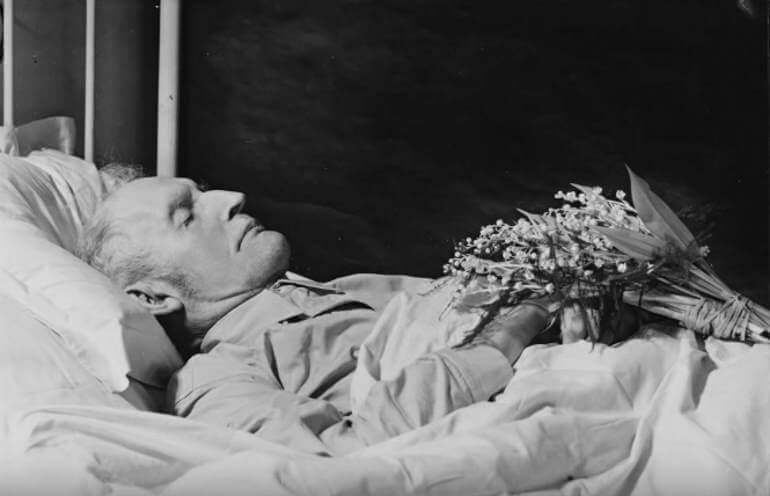
in the parlor or funeral room. The custom of “sitting up with the dead” is also called a “Wake”. Most times a handmade quilt would be placed over the body along with flowers and herbs. The ritual of sending flowers to a funeral came from this very old tradition. The aroma from the profusion of flowers around the deceased helped mask the odor of decomposition.

Flowers as a form of grave decoration were not widely used in the United States until after the mid-nineteenth century. In the Southern Appalachians, traditional grave decorations included personal effects, toys, and other items such as shells, rocks, and pottery sherds. Bunches of wildflowers and weeds, homemade plant or vegetable wreaths, and crepe paper flowers gradually attained popularity later in the nineteenth century. Placing formal flower arrangements on graves was gradually incorporated into traditional decoration day events in the twentieth century.

The day after the Wake, the body would be loaded into a wagon and taken to the church for the funeral service. Family and friends walked behind the wagon all dressed in black. The church bell would toll until the casket was brought into the church. This would be the last viewing as friends and family walked past the casket to take a final look at the body. Some would place a variety of objects in the coffin such as jewelry, tobacco, pipes, toys, a bible and every once in an alcoholic beverage.

Today, a strong sense of community continues to dominate Appalachian burial customs even though the modern funeral industry has changed the customs slightly. The social dimension has changed completely since caskets are commercially produced and graves are seldom dug by hand. Modern funeral homes have made the task of burial more convenient but the downside is there is less personal involvement. Personalized care for the dead is an important aspect of family and community life in Appalachia. And we can certainly say for sure that the days of conducting the entire procedure necessary to bury a person, all done by caring neighbors, with no charge involved, are no longer practiced.

Sunday, February 18, 2018

11 Fascinating Facts about the Victorians


Health professionals in the Victorian era were constantly innovating and suggesting new and interesting ways to fight illnesses. In 1875 one recommendation was to cover oneself in sheets of newspaper, providing a warm and comfortable night’s sleep while reducing the onset of pneumonia.


1)  Read All About It 

The Victorian period was a time of discovery, rebellion and exploration for those who lived through it. It was also a prosperous time for Sudeley, which saw many improvements under the watchful eye of owner, Emma Dent. As we prepare to host our annual Victorian May Day celebrations, read on find out 11 interesting things you probably didn’t know about the era.


2) An Everyday Poison 

Toxic arsenic was widely consumed by Victorians. Women believed it had qualities which made skin appear younger, and so it was a major ingredient in many cosmetics – whereas men would consume arsenic pills as a way of stimulating their libido. Unsurprisingly, these products caused extreme sickness and lead to many fatalities before people understood the true power of the substance.


3)  Curious Collections 

Many Victorians would specialise in collecting objects, from zoological and botanical to geological and archaeological. People devoted cabinets and spaces for their prized collections, which would often take up entire rooms in their home. During the era many towns and villages had a curiosity shop which sold an array of weird and wonderful objects to avid collectors.


4) Widow of Windsor

It’s well documented that when Queen Victoria’s husband, Prince Albert, died in 1861, she went into mourning and wore black until her death 40 years later. During this time she secluded herself from the rest of the world and was rarely seen in public, earning herself the name of the ‘Widow of Windsor’. But did you know, Victoria disliked black funerals and at her own funeral in 1901, ensured the streets of London were decorated in purple and white.


5)  Walk Like an Egyptian 

In the Victorian era, people were fascinated by ancient Egypt. Many historians believe this was down to the parallels that could be drawn from their relationships with death. In fact, Egyptian influences can be found in women’s mourning jewellery from the era. This obsession led to an unusual phenomenon whereby experts would unwrap mummies for an auditorium of curious men and women.


6)  The Penny Black 

The Victorian era has often been described by historians as the ‘Golden Years’ as it was a hugely important time for innovation. One of these innovations was the concept of the postage stamp, which first became available for purchase on 1 May 1840. The first stamps, The Penny Black and the Two Pence Blue, included the image of a young Queen Victoria, and to this day, the UK is the only country which uses the reigning monarch’s head for national identification rather than the country’s name.


7) Sprechen sie Deutsch? 

The British royal family is German in origin – in fact Queen Victoria’s mother, Victoria of Saxe-Coburg, was a German princess. The Queen was brought up by her German governess, Baroness Louise Lehzen, from Hanover, and as such, Victoria spoke only German until she was three years old. Even as an adult, German was spoken in Buckingham Palace and at all private occasions, with many of Victoria’s courtiers, including her husband, Prince Albert, being German.


8)  50 Shades Of Black

As well as mourning loved ones, there was another, more practical reason, why so many Victorians wore a lot of black – it was all down to pollution. Industry was booming in the Victorian era, and as such pollution was rife – particularly in the cities – meaning that women who wore light colours would find their dresses turn shades of grey, and so opted for darker clothing.


9)  Look Into My Eyes 

Victorians were big advocates of spiritualism and believed in the afterlife. Public events involving hypnosis, séances and fortune telling were popular occasions during the era, and it was big money for the people performing these acts. However, unsurprisingly many of these professionals were simply good actors maximising on peoples gullibility.


10)  Hostess With The Mostess 

If a lady was at home in the day she was expected to be properly dressed and prepared for visitors between the hours of 3pm and 5pm. The time visitors could arrive was dependent on how familiar an acquaintance they were, with closer friends and family permitted to visit later in the day. It would have been seen as poor taste for anyone to arrive earlier than 3pm.


11) Say My Name

Queen Victoria wasn’t actually called Victoria – she was in fact named Alexandrina after her godfather, Tsar Alexander I of Russia. Victoria was a middle name which she shared with her mother. However, until her coronation in 1838 she was known as Drina and many of the public at the time were never certain of her official name.


Article by Holly Jones ~ Castle & Gardens
April 26, 2017

Friday, March 17, 2017

Victorian Funeral Customs and Superstitions

Victorian Funeral Customs and Superstitions

Curtains would be drawn and clocks would be stopped at the time of death. Mirrors were covered with crape or veiling to prevent the deceased’s spirit from getting trapped in the looking glass.  A wreath of laurel, yew or boxwood tied with crape or black ribbons was hung on the front door to alert passersby that a death had occurred. The body was watched over every minute until burial, hence the custom of “waking”.  The wake also served as a safeguard from burying someone who was not dead, but in a coma.  Most wakes also lasted 3-4 days to allow relatives to arrive from far away. The use of flowers and candles helped to mask unpleasant odors in the room before embalming became common. In 19th century Europe and America the dead were carried out of the house feet first, in order to prevent the spirit from looking back into the house and beckoning another member of the family to follow him.  Family photographs were also sometimes turned face-down to prevent any of the close relatives and friends of the deceased from being possessed by the spirit of the dead.

Grave robbery by the “Resurrectionist Men”, often doctors themselves was a problem in the 19th century as medical schools needed fresh cadavers for dissection classes.  “Bricking-over” a grave was a way of guaranteeing some security after death. The fear of a loved one being buried alive inspired coffin makers to design warning systems such as a bell on the grave which was connected by a chain to the inside of the coffin in cases of premature burial, thus the expression, “Saved by the bell.”  Small cakes, known as “funeral biscuits” were wrapped in white paper and sealed with black sealing wax and given to guests as favors. Lavish meals, or collations, were often served after internment. Burial usually followed four days after death.

In many cemeteries, the vast majority of graves are oriented in such a manner that the bodies lie with their heads to the West and their feet to the East. This very old custom appears to originate with the Pagan sun worshippers, but is primarily attributed to Christians who believe that the final summons to Judgment will come from the East.

Personal stationery and handkerchiefs carried a black border, with a wide border indicating a very recent death.

White was a popular color for the funeral of a child. White gloves, ostrich plumes and a white coffin were the standard.

Superstitions

If the deceased has lived a good life, flowers would bloom on his grave; but if he has been evil, only weeds would grow.

If several deaths occur in the same family, tie a black ribbon to everything left alive that enters the house, even dogs and chickens. This will protect against deaths spreading further.

Never wear anything new to a funeral, especially shoes.

You should always cover your mouth while yawning so your spirit doesn’t leave you and the devil never enters your body.

Stop the clock in a death room or you will have bad luck.

To lock the door of your home after a funeral procession has left the house is bad luck.

If rain falls on a funeral procession, the deceased will go to heaven.

If you hear a clap of thunder following a burial it indicates that the soul of the departed has reached heaven.

If you hear 3 knocks and no one is there, it usually means someone close to you has died. The superstitious call this the 3 knocks of death. 

It is bad luck to meet a funeral procession head on. If you see one approaching, turn around.  If this is unavoidable, hold on to a button until the funeral cortege passes.

Large drops of rain warn that there has just been a death.

If you leave something that belongs to you to the deceased, that means the person will come back to get you.

If a firefly/lightning bug gets into your house someone will soon die.

If you smell roses when none are around someone is going to die.

 If you don’t hold your breath while going by a graveyard you will not be buried.

If you see yourself in a dream, your death will follow.

If you see an owl in the daytime, there will be a death.

If you dream about a birth, someone you know will die.

If it rains in an open grave then someone in the family will die within the year.

If a bird pecks on your window or crashes into one that there has been a death.


If a sparrow lands on a piano, someone in the home will die.

If a picture falls off the wall, there will be a death of someone you know.

If you spill salt, throw a pinch of the spilt salt over your shoulder to prevent death.

Never speak ill of the dead because they will come back to haunt you or you will suffer misfortune.

Two deaths in the family means that a third is sure to follow.

The cry of a curlew or the hoot of an owl foretells a death.

A single snowdrop growing in the garden foretells a death.

Having only red and white flowers together in a vase (especially in hospital) means a death will soon follow.

Dropping an umbrella on the floor or opening one in the house means that there will be a murder in the house.

A diamond-shaped fold in clean linen portends death.

A dog howling at night when someone in the house is sick is a bad omen. It can be reversed by reaching under the bed and turning over a shoe.

Information Gathered From Friends of Oak Grove Cemetery


Mourning in the Georgian Era

by Geri Walton

Everyone is usually familiar with Victorian mourning and its strict etiquette and rules. Mourning in the Georgian Era also had rules associated with it and those rules varied. For instance, in 1782 there was no general mourning when Prince Alfred died as etiquette established “never to go into mourning for any of the blood-royal of England under 14 years of age, unless [they were] … the heir-apparent.” When the Princess Dowager died, mourning lasted six months and theatres were closed for three weeks, whereas when Princess Amelia of Great Britain died in 1786 the mourning period lasted six weeks and theatres were closed for a mere ten days.

Georgians, just like Victorians, wore black when in mourning. Black was worn to denote privation of life,” as black was considered the “privation of light.” The Irish author and satirist Jonathan Swift noted that despite wearing black, Georgian Era mourning was sometimes neither strict nor somber. He demonstrated this when he wrote that “he always observed the merriest faces in mourning coaches.” One gentleman added to Swift’s comment that “black clothes are but seldom accompanied with sorrowful countenances.” The gentleman also maintained that at least two women he knew, who had not recently lost a relative, became “very  “the melancholy” as mourning clothes were of “great advantage to their complexions.”

The two melancholy women mentioned above were not the only ones to show improper decorum when it came to mourning. For instance, it was reported that a man named Sir Henry Lovejoy went to a new play “in black and weepers; and though he had buried his wife but a week, he laughed as hearty as if he was to have been married the next day.” There was also a certain lady who reputedly danced at Cornelys’ just a fortnight after her husband’s death, and a son whose father had so severely restricted his finances, that upon the father’s death the son “immediately rifled the strong box … and swore he would not return home till his father was buried, and every farthing spent.”

Although some Georgians were willing to abide by proper etiquette and rules when it came to mourning, one Georgian gentleman in 1769 felt that disrespectful mourning had gotten out of hand. He wrote to the editor of the Town and Country Magazine hoping to improve the decorum of Georgian mourners. He stated that if that happened “foreigners will no longer be able to twit us with all want of decency; and we shall approach a little more towards rational beings.” He also offered various rules and etiquette for Georgians mourners, and provided a bit of humor with it. He suggested his ideas be used by wives mourning for their husbands, husbands mourning for their wives, and heirs mourning for their fathers.

Here are his suggestions:

Wives Mourning for Their Husbands:
  • The first week wives were not to appear in public.
  • They were also not to be without a handkerchief, even in private.
  • The second Sunday they were to be “much affected with the sermon; the handkerchief not omitted.”
  • After the first month, the widowed wife could attend a tragedy and then “weep in character, either at the play, or the loss of her husband.”
  • The second month, she was allowed to attend a comedy and she could “smile but not languishingly.”
  • The third month, allowed for laughter at a play or dancing at Cornelys’ with her perspective bridegroom.
  • The fourth month permitted her to jump into her intended arms, and “finish her widow-hood.
Husband’s Mourning for Their Wives:
  • The husband was directed to “weep, or seem to weep at the funeral.”
  • He could not be seen at the chocolate house for the first week and was supposed to provide a “proper sigh whenever good wives, or even matrimony [was] mentioned.”
  • The third week allowed for a mistress, if he did not have one.
  • The fourth week he could appear in public.
  • The second month he could obtain more mistresses if he chose not to marry, as mistresses supposedly provided solace for his melancholy.
Heirs Mourning for Their Fathers:
  • The heir was instructed not to leave before the funeral ended, although horses, dogs, and equipages could be readied for his departure.
  • The disposition of the estate, gardens, etc. could be examined.
  • Additional servants could be hired if needed and they could be put into mourning.
  • Immediately after the funeral women were allowed to call on the heir or he could visit them.
  • The heir could also frequent the “gaming table [or] get admitted [as] a member of the Jockey Club [or] the Franciscan Friars.”
  • Finally, if not ruined by too early expiration of his mourning, he could also discard his mourning dress.
Of course, not everyone was so lighthearted when it came to death and mourning. Public figures had epic funerals and associated with them was epic mourning. For instance, when Horatio Nelson, 1st Viscount Nelson, died, besides a specific order in which the funeral procession was to proceed, there were numerous mourning coaches and his body was covered with a black velvet pall. Nelson’s servants were also “in mourning” and rode in a “mourning coach,” and at least one mourning coach bore several gentlemen “in their full uniform coats, with black cloth waistcoats, breeches, and black stockings, and crape round their arms and hats.” In 1798, there was a report of a woman dressed in deep mourning who had lost her husband and two sons in the war. She hoped to present a petition to the majesties but was prevented, although she eventually succeeded in throwing her petition into their carriage, where it fell upon Princess Elizabeth’s lap.

Mourning rules were also associated with families, relatives, and servants in the Georgian Era. In the Life of Harriot Stuart, written in 1750 by the English poet and authoress, Charlotte Lennox, she noted:

“[The] length of time devoted to mourning, and the apparent intensity with which one mourned, were determined to a large extent by the relationship that … existed between the two people and the ‘public knowledge of that relationship’ … mourning was usually only done for kindred, and … the formal rules that governed mourning, which specified an exact amount of time for each degree of kinship, ‘showed that servants were excluded from family.'”

This meant that mourning by any employer for one of their servant’s, indicated their relationship was more of a friendship than mere employer and domestic.

References:
Annual Register, Vol. 1798, 1800
Friday’s Post, in Ipswich Journal, pg. 2, 24 August 1782
“Friday’s Post and Express,” in Norfolk Chronicle, pg. 4, 2 October 1790
Lennox, Charlotte, The Life of Harriot Stuart, Written by Herself, 1750
The European Magazine and London Review, Vol. 49, 1769
The Order to be Observed in the Public Funeral Procession of the Late Vice-Admiral Horatio Viscount Nelson, Vol. 8, 1806
“Wednesday & Thursday’s Posts,” in Northampton Mercury, pg. 2, 4 November 1786

Urban, Sylvanus, The Gentleman’s Magazine and Historical Chronicle, 1806